
Alesis Recital
A practical digital piano with semi-weighted keys and 88 keys, best judged on how the keys feel for the way you play.
Digital pianos are one of the most popular ways to start learning, and for good reason. This guide explains why they suit beginners and what features a beginner actually needs.
Yes - digital pianos are excellent for beginners: they offer realistic weighted keys, headphone practice, no tuning, and a lower cost than an acoustic, all in a compact form. For a beginner, the key things to get right are 88 fully-weighted keys, touch sensitivity and a sustain pedal. With those, a digital piano gives a genuine foundation in piano technique from day one.
Digital pianos remove the barriers of an acoustic: they are cheaper, never need tuning, take less space, and let you practise silently with headphones at any hour. A good one still gives the weighted feel and authentic sound needed to learn properly. For most beginners, especially in a home or flat, a digital piano is the practical and effective way to start.
Features like hundreds of voices are nice but not necessary.
Beginners often pay for things that do not help learning: hundreds of extra voices, rhythms, and gimmicky features. What matters is key feel, sound and a sustain pedal, not the spec-sheet extras. A simpler piano that nails the fundamentals is a far better beginner buy than a feature-packed one with a poor key action.
Beyond the piano, a beginner benefits from a stable stand, a bench at the right height, a sustain pedal and headphones. Portable pianos often sell these separately, so budget for them. Good posture and a proper setup make practice more comfortable and effective, helping a beginner build good habits and stick with learning.
A practical digital piano with semi-weighted keys and 88 keys, best judged on how the keys feel for the way you play.

A practical digital piano with weighted keys, best judged on how the keys feel for the way you play.

A practical digital piano with fully weighted hammer-action keys and 88 keys, best judged on how the keys feel for the way you play.

A practical digital piano with graded hammer action (fully weighted), best judged on how the keys feel for the way you play.

A practical digital piano with hammer-action weighted keys, best judged on how the keys feel for the way you play.
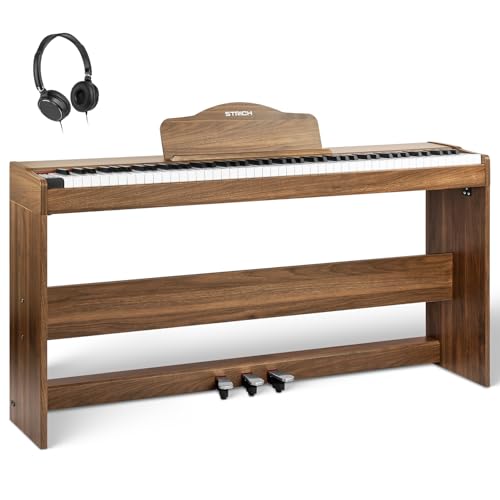
A practical digital piano with fully weighted hammer-action keys and 88 keys, best judged on how the keys feel for the way you play.
Yes - they offer realistic weighted keys, silent headphone practice, no tuning and lower cost than an acoustic, in a compact form. Get 88 fully-weighted keys, touch sensitivity and a sustain pedal, and a beginner has a genuine foundation.
88 fully-weighted keys, touch sensitivity, a sustain pedal, a natural piano sound and a headphone output. These fundamentals matter far more than hundreds of voices or gimmicky features for learning piano properly.
For most beginners, yes - digital pianos are cheaper, never need tuning, take less space and allow silent practice with headphones, while still offering weighted keys and authentic sound. They are the practical way to start.
Our top pick is the Alesis Recital (our score 9.6/10) - A practical digital piano with semi-weighted keys and 88 keys, best judged on how the keys feel for the way you play..