
Alesis Recital
A practical digital piano with semi-weighted keys and 88 keys, best judged on how the keys feel for the way you play.
Digital and acoustic pianos each have real strengths, and the right choice depends on your priorities. This guide compares them on feel, sound, price, maintenance and practicality.
Choose a digital piano for affordability, silent practice, low maintenance and compactness, and an acoustic piano for the ultimate feel and sound if you have the budget, space and commitment. Modern digital pianos get remarkably close to the real thing for far less hassle, which is why most learners and many experienced players choose them. Acoustics remain unmatched for pure feel and tone, at a cost.
An acoustic piano still has the edge in pure feel and tone, with a responsive action and rich, resonant sound no digital fully matches. But good digital pianos get very close, with weighted hammer actions and sampled or modelled sound that satisfies most players. For the very best feel and sound, acoustic wins; for excellent results with practicality, digital is superb.
Digital pianos are far cheaper to buy and need no tuning or maintenance, beyond the odd care. Acoustic pianos cost much more, need regular tuning (a recurring cost), and are sensitive to humidity and temperature. Over years, the ownership cost and hassle of an acoustic are significantly higher, which is a major practical point in the digital piano's favour.
Digital pianos are compact, movable, and allow silent practice with headphones at any hour - ideal for flats, families and shared spaces. Acoustics are large, heavy, fixed, and audible to the whole household, with no headphone option. For most modern homes, the digital piano's practicality is a decisive advantage unless you have the space and freedom for an acoustic.
Pick a digital piano if you value price, silent practice, low maintenance and space - which covers most learners and homes. Pick an acoustic if you have the budget, space and commitment and want the ultimate feel and sound, and do not need silent practice. Many serious players are perfectly happy with a quality digital piano.
A practical digital piano with semi-weighted keys and 88 keys, best judged on how the keys feel for the way you play.

A practical digital piano with weighted keys, best judged on how the keys feel for the way you play.

A practical digital piano with fully weighted hammer-action keys and 88 keys, best judged on how the keys feel for the way you play.

A practical digital piano with graded hammer action (fully weighted), best judged on how the keys feel for the way you play.

A practical digital piano with hammer-action weighted keys, best judged on how the keys feel for the way you play.
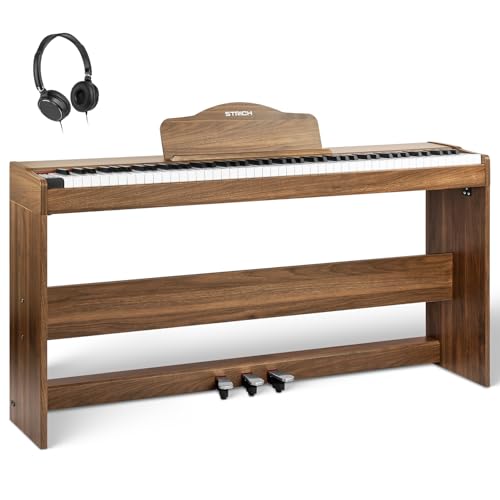
A practical digital piano with fully weighted hammer-action keys and 88 keys, best judged on how the keys feel for the way you play.
Modern digital pianos get remarkably close in feel and sound for far less cost and hassle, which is why most learners choose them. Acoustics still have the edge in pure feel and tone, but digitals are excellent and far more practical.
A digital piano is cheaper, needs no tuning, is compact and allows silent headphone practice; an acoustic offers the ultimate feel and sound but is large, expensive, needs tuning and is audible to all. Choose by your priorities.
Choose digital for price, silent practice, low maintenance and space - which suits most learners and homes. Choose acoustic if you have the budget, space and commitment and want the very best feel and sound.
Our top pick is the Alesis Recital (our score 9.6/10) - A practical digital piano with semi-weighted keys and 88 keys, best judged on how the keys feel for the way you play..