Donner DDP-80 vs Alesis Recital Pro
We compare the Donner DDP-80 and the Alesis Recital Pro across every dimension that matters - our scores, the key specs, and how each performs on the things you will actually notice day to day.
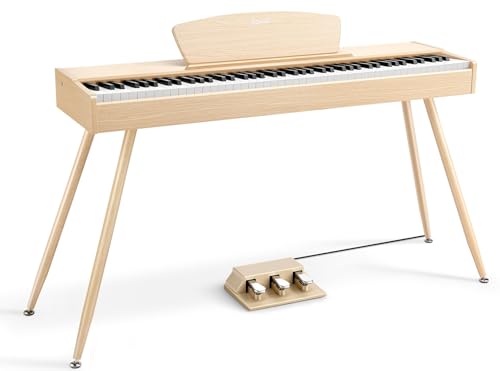

At a glance
| Donner DDP-80 | Alesis Recital Pro | |
|---|---|---|
| Our score | 8.3/10 | 9.0/10 |
| Best for | Beginners and improvers who want a realistic, weighted feel | Beginners and improvers who want a realistic, weighted feel |
| Not ideal for | Players wanting a premium acoustic feel or a furniture-style console | Players wanting a premium acoustic feel or a furniture-style console |
| Brand | Donner | Alesis |
Keys and Action
Donner DDP-80
With an 88-key layout, the Donner uses a full hammer-action, weighted keybed designed to mimic the feel of an acoustic grand piano. This is intended to make finger strength and attack more responsive than on lighter, unweighted keyboards, which can help keep dynamics controlled during practice and note-heavy passages. The 88-key digital piano is positioned for learning, where touch consistency matters, especially when moving from lessons on a traditional piano. A heavier keybed may tire some beginners, so hands may need an adjustment period.
Alesis Recital Pro
The Alesis is built around 88 full-sized hammer action keys, delivering a traditional piano feel. The touch response is adjustable so the action and dynamics can be tailored to a preferred playing style, and the pedal input supports sustain.
Sound and Tone
Donner DDP-80
Sound on the digital piano is powered by the Advanced French DREAM sound source, which is designed to support a realistic piano-style output for practice and learning. In everyday use, the 2 x 25W stereo surround speakers help fill a room, and the 88-key hammer-action design supports consistent dynamics. With 128 max polyphony, fast passages are less likely to cut off notes, although extremes may still sound limited compared with higher-end models. For quieter sessions, the headphone output also helps for silent practice. When comparing the Donner with the digital piano sold on Amazon, buyers should consider what audio accessories are included, since bundles can vary.
Alesis Recital Pro
Sound from the digital piano comes through built-in 20 W speakers, designed to provide room-filling playback without an external amplification setup. This built-in speaker output supports normal home practice, since the piano does not require an extra sound system. For quieter listening, it includes a ¼ inch (6.35 mm) stereo headphone output. There is also a separate ¼ inch (6.35 mm) sustain pedal input, helping keep playing timing responsive. In the Alesis price discussion, the question of whether the built-in speakers suit a given room size comes up frequently, and for some players they will.
Built-in Voices and Features
Donner DDP-80
The Donner DDP-80 pairs its built-in sound source and speaker system with a set of built-in voices and practical onboard features, designed to support practice and songs without needing constant external equipment. The advanced French DREAM sound source supports up to 128-note polyphony, which helps during faster passages or layered playing. The instrument also includes a headphone practice mode and uses a triple-pedal system for clearer expression. For learning and workflow, it connects via USB-MIDI to iPad or mobile apps, and it can link to PC software for internal records. For those searching for the Donner best price UK, these built-ins reduce the need for additional add-ons.
Alesis Recital Pro
Built-in voices and learning tools are a key part of what the digital piano offers for beginners, because it includes twelve expertly crafted voices intended to help new players get started quickly. The Recital Pro is described as featuring educational tools designed to help beginners start performing faster. The keyboard uses 88 full-sized hammer-action keys with adjustable touch response, allowing a player to match their preferred feel. Voices can be used during practice sessions, including through stereo headphone output for quiet playing. On Amazon UK listings for the Alesis Recital Pro, these built-in features are presented in a straightforward way, although only basic details are provided.
Speakers and Volume
Donner DDP-80
The digital piano's speaker system is built around two stereo surround speakers, each rated at 25W (maximum power). This arrangement is designed to deliver fuller home-room sound for practice and casual playing, with chords and melody lines spreading more easily across a room than on single-speaker designs. For quieter sessions, headphone mode helps reduce disturbance, although overall perceived loudness depends on room size and speaker placement. When comparing the donner ddp-80 price, the sound benefits are most noticeable at normal practice volumes, because very detailed dynamics are limited by the system.
Alesis Recital Pro
A solid speaker setup matters for practice, and the Alesis includes built-in 20W speakers that deliver room-filling sound for everyday playing. This means there is no need to plug in an external amplifier just to hear the notes clearly. In the Alesis Recital Pro digital piano context, having sound ready on arrival also helps when space is limited. Volume control is straightforward. For quiet sessions, there is a ¼ inch stereo headphone output for private practice, while speaker output still needs to be managed by the player.
Connectivity and Apps
Donner DDP-80
How well the Donner works with other devices depends on its basic connection options and how they are set up for practice or recording. For the digital piano, it offers USB-MIDI for linking to music software, plus a headphone output for quiet sessions. A user can connect the teaching app on iPad and mobile phone for self-study, composition, or lessons, then use PC music editing software for internal records. The process is usually simple: plug in via USB-MIDI, open the app or software, and select the piano input. Headphones support practice at any time, but external speakers are not used there. The Donner piano review highlights this flexibility, although specifics on app compatibility are not stated.
Alesis Recital Pro
Connectivity on the Alesis supports both shared-room practice and private practice primarily via its stereo headphone output (¼ inch / 6.35 mm) and its sustain-pedal connection through a ¼ inch (6.35 mm) input. In the context of The digital piano comparisons, including searches for "best digital piano uk", the practical consideration is how it accommodates basic external gear. For quiet sessions, headphones connect to the stereo headphone output, and the sustain pedal can be connected to control note length. The sustain pedal is not included, although the input is supported, so buyers need to check what comes in the box.
Design and Portability
Donner DDP-80
The digital piano's DDP-80 is built around a furniture-style wooden look, and it comes in a walnut wood colour with an odourless process. For the Donner DDP-80 digital piano intended for home placement, the 42.9 kg weight and tall profile help it feel stable, but moving it between rooms needs care. It is supplied with included legs, which affect the setup height: without legs it measures 75 cm, and with legs it is also 75 cm. The width is 149.9 cm and the depth is 45 cm with the legs included. Assembly is described as quick, which supports practicality for people searching for "donner ddp-80 worth it" style decisions.
Alesis Recital Pro
Even when headphones and a sustain pedal cover most quiet-practice needs, the way this digital piano looks and moves matters for where it gets used, such as a bedroom, a practice room, or a small studio. With 88 full-size hammer-action keys and a premium, robust mechanism, it feels stable on a stand, though it is not described as lightweight. The cabinet design is built for daily reliability, and the chrome sustain pedal action supports consistent setup. For players looking for a best weighted digital piano, the included pedal and polarity switch access support quick compatibility checks.
Who Is This Digital Piano For?
Donner DDP-80
Who is the Donner best suited for, and who may find it less convenient? It is aimed at learners and teachers who want an 88-key, fully weighted keyboard with a grand-piano style feel for at-home practice, lessons, and basic composition. It suits players who plan to use MIDI via USB, connect it to an iPad or mobile teaching app, or work with PC music editing software, as those setups are designed to be straightforward. Headphone practice is also supported, as headphone output is available. It may be less convenient for apartment dwellers who need frequent portability, since it weighs 24.95 kilograms, so it is only the best weighted digital piano choice if moving is rare.
Alesis Recital Pro
Who is the Alesis aimed at, and who might find it less suitable? It suits people who want a top digital piano for beginners, especially those learning on 88 full-sized hammer action keys with adjustable touch response, and who like twelve voices plus built-in educational features. It is also practical for quiet practice, because it offers a ¼ inch stereo headphone output and 20 W built-in speakers. It may be less suitable for advanced players who require features beyond the stated inputs, or for buyers expecting an included sustain pedal, since no sustain pedal is included. For parents, it is sized for home lessons. The question "is the Alesis Recital Pro any good" depends on matching these priorities to the buyer's needs.
Donner DDP-80: pros
- Hammer-action weighted keys
- Full board (88 keys)
- Connectivity: USB-MIDI, headphone output
- Bundle includes stand, pedal, headphones
Cons
- Built-in speakers rarely match headphone sound quality
Alesis Recital Pro: pros
- Hammer-action weighted keys
- Connectivity: headphone output
- Bundle includes pedal, headphones
- Straightforward to set up and play
Cons
- Built-in speakers rarely match headphone sound quality
Our verdict
Our pick is the Alesis Recital Pro (our score 9.0/10) - A practical digital piano with hammer-action weighted keys, best judged on how the keys feel for the way you play. The Donner DDP-80 is still worth it if it is cheaper when you check, or if it better matches your specific needs.