Yamaha P-225 vs Roland FP-E50
We compare the Yamaha P-225 and the Roland FP-E50 across every dimension that matters - our scores, the key specs, and how each performs on the things you will actually notice day to day.

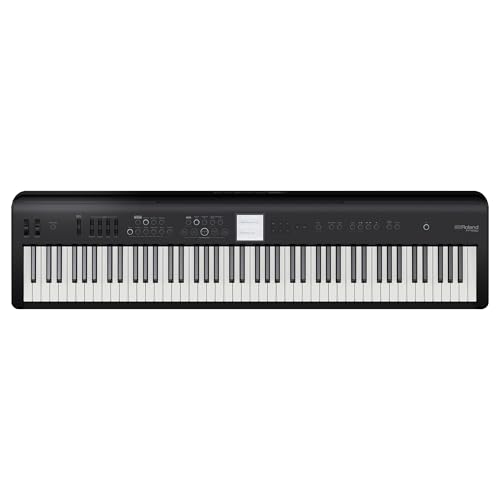
At a glance
| Yamaha P-225 | Roland FP-E50 | |
|---|---|---|
| Our score | 7.8/10 | 7.1/10 |
| Best for | Beginners and improvers who want a realistic, weighted feel | Beginners and improvers who want a realistic, weighted feel |
| Not ideal for | Players wanting a premium acoustic feel or a furniture-style console | Players wanting a premium acoustic feel or a furniture-style console |
| Brand | Yamaha | Roland |
Specifications compared
| Yamaha P-225 | Roland FP-E50 | |
|---|---|---|
| Keys | 88 Fully weighted | 88 notes |
| Action | Fully weighted graded hammer See description | Hammer-action weighted |
| Dimensions | 12.7D x 132.1W x 27.2H cm | 130D x 32.2W x 17.4H cm |
| Warranty | 2-year manufacturer warranty | 2 years |
Keys and Action
Yamaha P-225
Graded hammer action drives the Yamaha's feel, and it is built as a fully weighted 88-key keyboard designed to better mimic a real grand piano rather than a lighter synth-style action. The weighted "compact keys" are intended to provide steadier resistance across the keyboard, which supports switching between chords and single notes. For players seeking a piano-like response, the digital piano pros and cons emphasise comfort, particularly during longer practice sessions. The fully weighted keys can feel heavier than simpler keyboards, which may require adjustment.
Roland FP-E50
With its 88-note weighted hammer-action keyboard, the Roland is designed for players who want an acoustic-style feel rather than a light, synth-style action. The action is described as Standard 88-note hammer-action, aligning with the FP approach to responsive keys for piano practice. Players who already prefer weighted dynamics should find the key travel and feel familiar, particularly for sustained phrases and softer passages. Those expecting a different action type, such as lighter semi-weighted designs, may need time to adjust. Overall, the action supports learning, performing, and writing music.
Sound and Tone
Yamaha P-225
Stereophonic Optimiser support shapes how the Yamaha's sound comes across through headphones, aiming to reduce the flat feel many players notice with typical headphone listening. This matters because the compact unit uses weighted graded hammer compact keys for control, then routes the resulting dynamics into its overall tone. The P-225 includes 24 quality voices, so players can pick different timbres for practice, while the tone is described as clear rather than muddy. Through speakers, volume and clarity are described as strong.
Roland FP-E50
Sound and tone on the digital piano centre on The Roland's Piano sound engine and its expandable ZEN-Core sound engine, which together aim to cover both acoustic-style piano needs and wider music-making tasks. The Piano sound engine is designed for an authentic grand piano feel, while ZEN-Core adds 1018 onboard sounds, including synthesizers, orchestral and world instruments, guitar, bass and drums, with more possible via The digital piano packs. For buyers weighing the roland fp-e50 price, the blend supports solo practice and layered composing, though sound variety depends on downloaded expansions.
Built-in Voices and Features
Yamaha P-225
The digital piano's headphone tone support from the previous section complements its built-in options, because the choice of sound and control features directly affects what you hear during practice. The Yamaha P-225 includes 24 voices designed to keep sessions varied for both beginners and experienced users. Voices can be selected during practising, and the Stereophonic Optimiser is intended to make headphone listening feel more natural, which is useful when there is no speaker use. The compact body measures 12.7D x 132.1W x 27.2Hcm, and the keyboard also includes a footswitch that supports performance control. For buyers comparing options, the "Yamaha best price UK" focus may shift depending on bundle value.
Roland FP-E50
Built into the Roland FP-E50 is a piano-and-entertainment focused set of voices and features for learning, performing and writing music. It includes 1018 onboard sounds from the expandable ZEN-Core engine, covering synths, orchestral, world, guitar, bass and drums. Players can use interactive accompaniments with professional styles, plus additional Z-Style Packs, EXZ Wave Expansions and SDZ Sound Packs through The Roland. A mic input supports vocal effects, including real-time harmonies and voice transformer sounds. Bluetooth headphones are not supported. The Piano App supports sound choice and metronome setup.
Speakers and Volume
Yamaha P-225
Speakers and volume matter most because they shape how clearly the piano fills a room when headphones are not being used. With the digital piano, the practical trade-off is compact portability versus projection: it features built-in stereo output designed to sound full in small spaces, but it cannot match the output of larger cabinet digital pianos. At 13 kilograms and about 132.1W x 27.2H x 12.7D cm, it remains portable, so maximum room-filling volume is naturally limited. Buyers checking The Yamaha listings should consider placement carefully, particularly whether it will be positioned in open areas or close to walls.
Roland FP-E50
Quietly, the digital piano is designed to produce sound through its built-in speaker system, with an overall output level intended for typical home practice and casual performance. The Roland digital piano is suited to small rooms, where the built-in speakers can handle practice sessions without external amplification. For louder use, the unit supports headphone listening, which can help when neighbours or family are nearby. For more balanced sound, the keyboard volume can be adjusted to match room size and playing style.
Connectivity and Apps
Yamaha P-225
Connectivity is one of the practical reasons the digital piano can suit different home setups, as it includes a headphone output and uses a compact design at 13 kilograms. Its dimensions are listed as 12.7D x 132.1W x 27.2H cm, with an item depth of 12.9 cm in the supplied bundle details. For quiet practice, headphone use is supported, and the stereophonic optimiser aims to make the sound feel more natural. In this digital piano vs, best digital piano UK comparison, this model is also compatible with Rec'n'Share and App items. Setup requires the included AC adaptor.
Roland FP-E50
After looking at how volume and speakers affect day-to-day use, the next step is how the FP-E50 connects to other devices, since that shapes learning, recording and music-making. Bluetooth supports audio and MIDI for mobile interfacing, while USB-MIDI works for computer setups, and the headphone output supports private practice. The digital piano can manage sound selection and the metronome from a smartphone, which supports practice at home and in lessons. One limitation is that Bluetooth headphones are not supported, so a 6.35mm-style headphone jack remains the way to listen.
Design and Portability
Yamaha P-225
Built to suit smaller rooms and everyday routines, the Yamaha prioritises a space-saving layout while remaining suitable for serious practice. It weighs 13 kg and measures 12.7D x 132.1W x 27.2H cm, making it easier to move between rooms than a traditional piano. The black polished finish keeps the look tidy, and the music rest, footswitch, and AC adaptor are included. In use, the compact form helps reduce setup time because it can fit into narrower spaces, though it provides less visual presence than larger models. For buyers, the Yamaha P-225 price matters alongside its portability as the Yamaha P-225 digital piano.
Roland FP-E50
Design choices on this digital piano emphasise a compact stage-to-home fit, with a streamlined front panel for day-to-day control. At about 23 kilograms, it is portable for most users, though frequent moving may require lifting. The dimensions are 130D x 32.2W x 17.4Hcm, designed to suit desks and living rooms, with a black painted finish that keeps the front looking tidy. For the Roland buyer looking at the best digital piano UK options, the minimal control layout supports quick setup, while deeper functions rely on the app and menus. Bluetooth audio and Bluetooth MIDI support help with placement flexibility.
Who Is This Digital Piano For?
Yamaha P-225
Who is the digital piano (P 225BUK) best suited for, and who might find it limiting? It is aimed at beginners looking for an 88-key digital piano with fully weighted, graded hammer compact keys that aim to feel closer to a real grand. It is also suitable for experienced players who want a simple, compact instrument for practice, with 24 voices and headphone output, and a weight of about 13 kg for easier moving. It may be limiting for anyone wanting a large console-style instrument or deeper sound editing.
Roland FP-E50
The compact, desk-friendly layout and the weight of about 23 kilograms mean the Roland FP-E50 suits spaces where room is limited and where day-to-day control matters. It is a practical option for regular practice, particularly for learners who want an 88-note, hammer-action keyboard and authentic grand piano sound. It can also suit home sessions thanks to headphone output and mic input support, alongside Bluetooth audio/MIDI connectivity with mobile devices. It may be less ideal for players who need battery power or room-filling amplification.
Yamaha P-225: pros
- Graded hammer action (fully weighted)
- Connectivity: headphone output
- Compact for home use
- Straightforward to set up and play
Cons
- Stand, bench and pedal may cost extra
- Built-in speakers rarely match headphone sound quality
Roland FP-E50: pros
- Hammer-action weighted keys
- Full board (88 keys)
- Connectivity: Bluetooth, USB-MIDI, headphone output
- Straightforward to set up and play
Cons
- Stand, bench and pedal may cost extra
- Built-in speakers rarely match headphone sound quality
Our verdict
Our pick is the Yamaha P-225 (our score 7.8/10) - A practical digital piano with graded hammer action (fully weighted), best judged on how the keys feel for the way you play. The Roland FP-E50 is still worth it if it is cheaper when you check, or if it better matches your specific needs.