
Alesis Recital
A practical digital piano with semi-weighted keys and 88 keys, best judged on how the keys feel for the way you play.
Weighted and unweighted keys are the biggest difference between instruments, and it directly affects learning piano. This guide explains what each means and which you need.
For learning and playing piano, you want fully-weighted, hammer-action keys, which mimic an acoustic piano's resistance and build proper technique. Unweighted (synth-action) keys are lighter and easier to press, fine for casual keyboard playing and some other styles, but they do not develop piano finger strength and control. If piano is your goal, weighted keys are the feature that matters most.
Fully-weighted, hammer-action keys recreate the physical resistance of an acoustic piano, where hammers give each key a natural weight that is slightly heavier in the bass. Pressing them takes real finger strength and control, which is exactly what builds piano technique. This realistic feel is what makes a digital piano playable like the real instrument.
Unweighted (synth-action) keys are light and springy, easy to press quickly, and common on keyboards and synths. They suit fast playing, organ and synth styles, and casual use, and keep instruments cheap and light. The downside for pianists is that they do not build the finger strength and dynamic control that weighted keys develop, so technique learned on them does not transfer fully to a real piano.
Semi-weighted keys sit between the two: a little more resistance than synth-action, but not the full feel of a hammer action. They are a budget compromise found on some cheaper pianos and better keyboards. For serious piano learning, semi-weighted is a step down from fully-weighted; it is better than synth-action but still not the real thing.
Choose fully-weighted, hammer-action keys if you want to learn or play piano properly - it is the single most important feature for technique. Choose unweighted keys only if you want a keyboard for casual play, synth or organ styles, or maximum portability and low cost, and are not focused on classical piano technique.
A practical digital piano with semi-weighted keys and 88 keys, best judged on how the keys feel for the way you play.

A practical digital piano with weighted keys, best judged on how the keys feel for the way you play.

A practical digital piano with fully weighted hammer-action keys and 88 keys, best judged on how the keys feel for the way you play.

A practical digital piano with graded hammer action (fully weighted), best judged on how the keys feel for the way you play.

A practical digital piano with hammer-action weighted keys, best judged on how the keys feel for the way you play.
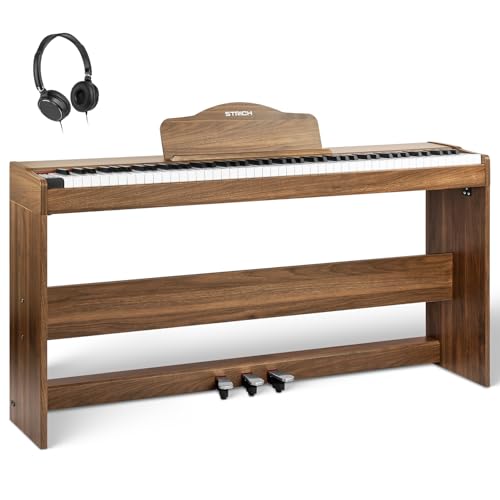
A practical digital piano with fully weighted hammer-action keys and 88 keys, best judged on how the keys feel for the way you play.
Yes, ideally - fully-weighted, hammer-action keys mimic an acoustic piano's resistance and build the finger strength and control piano technique needs. Unweighted keys are easier but do not develop proper technique.
Weighted (hammer-action) keys recreate an acoustic piano's resistance and build technique; unweighted (synth-action) keys are light and springy, suited to casual play, synth and organ styles, but do not develop piano finger strength.
Semi-weighted is a budget compromise - better than synth-action but not the full feel of a hammer action. For serious piano learning, fully-weighted keys are best; semi-weighted is a step down for technique.
Our top pick is the Alesis Recital (our score 9.6/10) - A practical digital piano with semi-weighted keys and 88 keys, best judged on how the keys feel for the way you play..